Months of complete closures without equivalent diversions jeopardise the survival of combined transport.
We are not discussing the need to renovate the rail network – it is urgently needed.
Nor are we questioning the causes of the dilapidated state of the network – they are well known.
We are talking about the consequences of a concept that shuts down entire corridors for five or more months at a time without providing reliable alternatives. This affects everyone: railways, operators, terminals, wagon owners, freight forwarders and logistics companies – and ultimately industry in Germany and Europe.
To put it plainly:
Refurbishment yes – but not at any price.
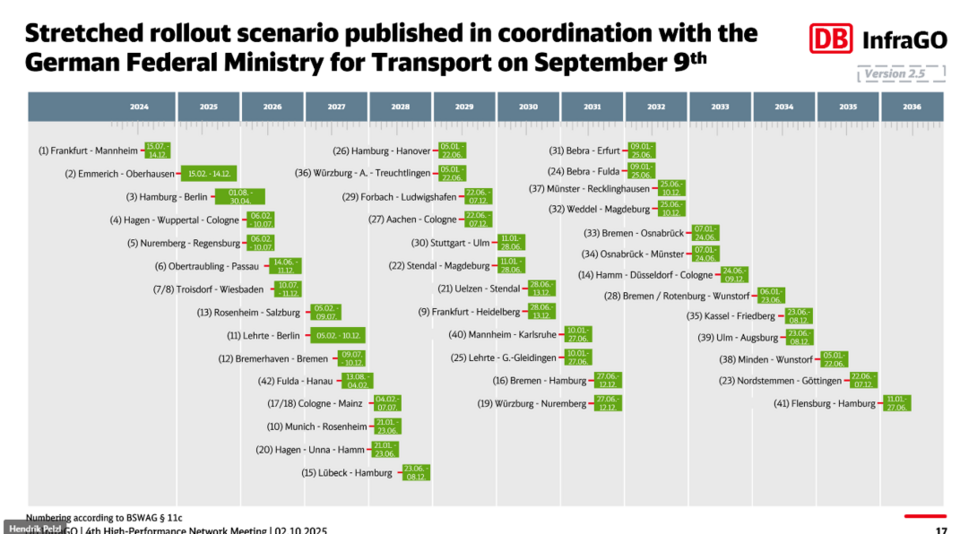
Corridor renovation: 40 full closures lasting 6 months each over 11 years
What combined transport achieves today – and the massive losses that threaten tomorrow without functioning diversions.
Combined transport delivers enormous benefits for the economy and the environment today – despite growing disruptions, bottlenecks and rising costs. But without reliable framework conditions and functioning diversions, there is a risk of a drastic loss of capacity. The figures show what we are achieving, what we are suffering from today – and what risks will arise tomorrow.
To put it plainly:
We are risking the grounding of large parts of combined transport.
5.6 million
truck loads
in combined transport in Germany in 2024
43%
Share of combined transport
in rail freight transport in Germany in 2024
2.8 billion
km by rail
for distances of Ø 500 km per shipment in the German network
4.5 million
tonnes of CO2 saved
at 0.8 tonnes of CO2 per lorry load
45%
Train punctuality
Arrival at terminal with < 1 hour delay
16%
Train cancellations compared to schedule
for operational reasons
+ 40%
Track access charge increase
compared to 2022
50%
Diverted freight trains
in transalpine traffic in 2028
-30%
Transport capacity
in the event of corridor closures without equivalent diversion routes
1.7 million
truck loads relocated
with a 30% loss in volume due to the cumulative effect of reduced capacity and rising costs
1.1 million
additional tonnes of CO2@
with a 25% shift back to road transport
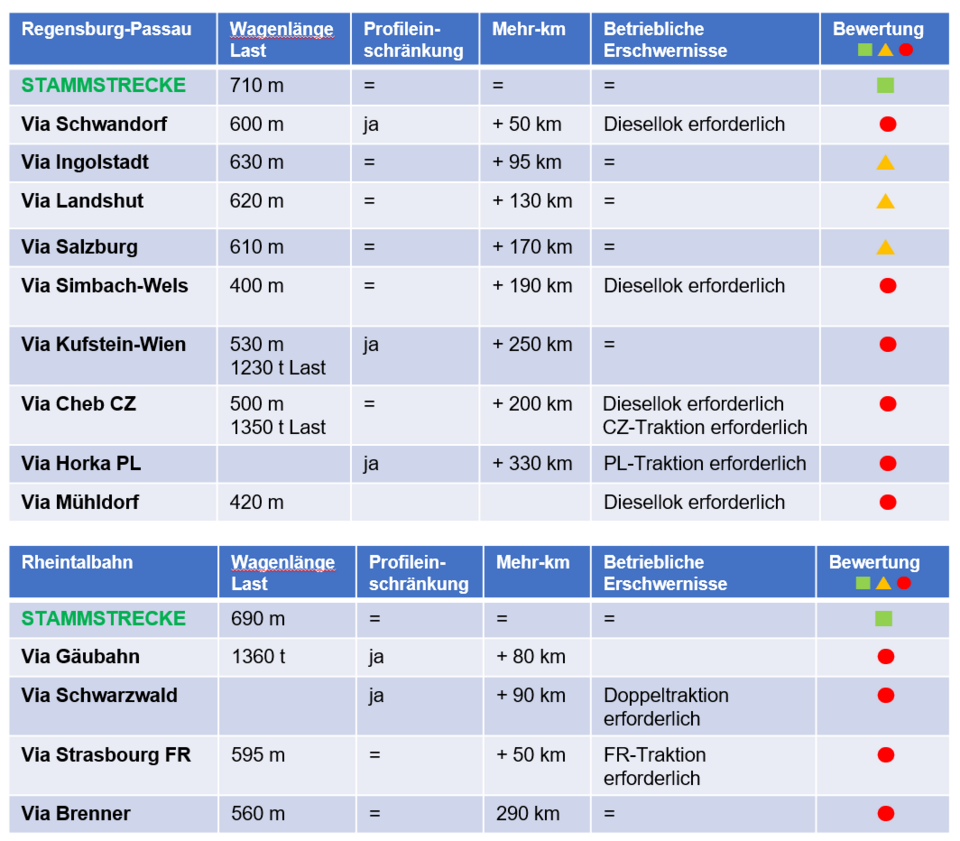
Corridor renovation: 40 full closures lasting 6 months each over 11 years
Many of the routes on offer are not viable from an operational or economic perspective – and therefore do not represent a genuine alternative.
- Trains must be shorter, lighter or run at lower speeds → less capacity.
- Long detours → significantly higher costs.
- Diesel traction, language change or other safety systems → often not operationally feasible.
A diverter that is not marketable is, in fact, not a diverter.
To put it plainly:
Many diversion routes are only alternatives on paper.
In concrete terms, shorter trains and fewer train paths mean huge capacity gaps – which immediately fill the roads.
Trains that are 100 metres shorter and 25% fewer train paths may sound abstract, but the consequences are not. During a six-month complete closure, our example shows a shortfall in capacity equivalent to 100,000 lorry loads.
In addition, fewer loads are spread across almost identical fixed costs. This means that costs rise by around 14% in mathematical terms – a further incentive to shift transport to the roads.
To put it plainly:
The road fills any capacity gap – immediately.
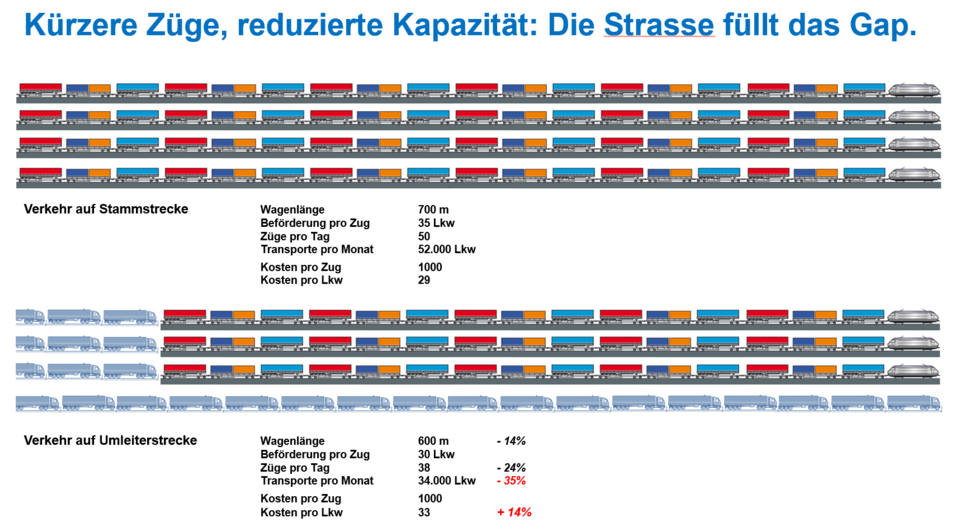
Trains 100 metres shorter, 25% fewer train paths: an example
Substandard diversions, rising costs and declining reliability trigger a vicious circle – with long-term consequences for rail transport.
Transport companies are already investing more in additional resources for road transport – a necessary measure to ensure they can continue to deliver on time. This sets in motion a dangerous mechanism: utilisation and thus the economic efficiency of combined transport services decline, train frequencies have to be reduced, attractiveness continues to decline – and in extreme cases, a connection is discontinued.
And once something has been shifted to road transport, it often does not return. This is because capacities are tied up, contracts are adjusted and processes are permanently geared towards road transport.
To put it plainly:
Relocation is the logical consequence of poor framework conditions.
